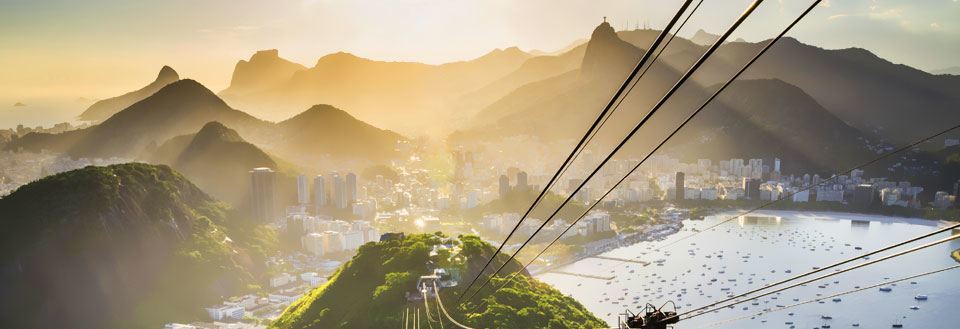
Soccer, carnival and dense tropical rainforest. Intense big-city vacation in fabled Rio de Janeiro or night-canoeing on crocodile-infested rivers. Brazil is a gigantic treasure box of yet undiscovered and already world-famous places. Just a tiny nibble of samba-land will satisfy your appetite.
Republica Federativa do Brasil
Brasilia (1,700,000)
8,511,965 square kilometres
Portuguese
Catholicism
172,860,370
Republic
At the heart of the country lies an enormous flat expanse from which small mountain ranges raise an occasional profile. The 7500-kilometre long coast is fenced off from the rest of the country by another small mountain range and it is characterized by long stretches of sand, quiet bays and numerous dotted small islands. The Northern part of Brazil possesses 20 per cent of the world's entire supply of freshwater - and the Amazon jungle contains (for now) 30 per cent of the world's forest.
In Brazil winter lasts from June to August and summer stretches from December to February. However it is only in the southern parts of Brazil that the seasons contrast significantly. During the summer months prices at the holiday destinations rise and the beaches are overcrowded. The tropical rainfall does not normally influence travel plans to Brazil.
REAL (R$), 1 Real = 100 centavos
It's no problem finding an Internet café in the Brazilian cities. Many of the major towns are also getting there and if you're at a tourist trap you can be sure to be able to get on the net at a restaurant or a hotel.
For emergency calls in Brazil dial:
Police (190)
Ambulance (192)
Fire Department (193)
Car accident (194)
Tipping is very common in Brazil - some places automatically add a tip to the bill (about 10 per cent). Wages in Brazil are very low and tipping is greatly appreciated. When the bill does not include tips you should give about 10 per cent. Also parking assistants, shoe shiners and street vendours will expect a tip.
Brazil has several time zones:
When it is 12 noon in the UK, it is 7 am in east, north-east, south and south-east Brazil.
When it is 12 noon in the UK, it is 6 am in western Brazil.
When it is 12 noon in the UK, it is 5 am in the westernmost areas.
A few areas change to summertime.
In Brazil they use the following units of measurement:
Weight: kilo
Distance: metre
In north-east Brazil some Brazilians still state distance in leagues instead of kilometres.
Brazilians are a rather photogenic people and many of them enjoy being photographed, but not all. Ask if you aren't sure, and you will seldom get an unfriendly answer. Avoid taking pictures in banks and near military installations. In some Candomblé temples (Afro-Brazilian religion) photography is prohibited.
In some cities you can drink water from the tap, but it's best to stick to bottled water.
Electricity isn't standardized in Brazil.
Bahia og Manaus:
127 V AC, 60 Hz
Brasilia og Recife:
220 V AC, 60 Hz
Rio de Janeiro og São Paulo:
110/220 V AC, 60 Hz
Punctuality is not a virtue in Brazil. Don't be offended if a Brazilian is a few hours late and don't feel embarrassed if you are late yourself. Brazilians greet people of the opposite sex with a mock kiss on both cheeks - even if it is their first meeting. Bathing trunks and sandals are not prohibited in the inner city, but such an outfit will stamp you as a common 'gringo'. Smart attire is highly respected in Brazil.
Banks are open from 10 am to 4.30 pm (Monday-Friday), Fridays some banks close a little earlier.
Shops are open from 9 am to 6 pm (Monday-Friday) and from 9 am to 1 pm (Saturdays).
Cuisine is influenced by African culture - imported to Brazil by slaves, and it varies from region to region. You can have a fantastic fruit juice, made of a fruit that you have never even heard of. Beach restaurants will usually serve grilled fish - and a particular Brazilian speciality is the bean stew, Feijoada,. For a drink then try caipirinha - made from lime and sugar cane liquor.
Wheelchair users do not have an easy time of it in Brazil. In the cities a few things have been done for disabled people, but in other places it can be very difficult to get about.
New Years Day, 1 January
Epiphany, 6 January
Tiradentes Day (revolutionary hero), 21 April
Labor Day, 1 May
Independence Day, 7 September
Our Lady Aparecida, 12 October
All Souls Day, 2 November
Proclamation of the Republic, 15 November
Christmas Day, 25 December
Carnaval, February or March
Easter, March or April
At more remote places camping is often a splendid alternative. Camping in a tent is also great if you are in one of Brazil's many national parks. In the cities you have to be prepared for the camping sites, if there are any, being situated far away from the city-centre.
A hotel in Brazil can be anything from a room with a bed and a sink to a luxury suite with a view over Rio. During off-peak season it can pays to haggle over the price. A 25-50 per cent reduction of the rate is not unusual. Some places will add a ten per cent service charge to the final bill.
Most travellers in Brazil stay at a pousada. It's a smaller guesthouse, usually family owned, which offers overnight accommodation and breakfast. Here, too, it can pay off to haggle the price during the off-peak season.
More and more hostels are opening up in Brazil. In the cities in particular it is a good and cheap solution. If you want a list of Brazilian hostels (albergues de juventude) you can click on:
http://www.hostel.org.br
Motels in Brazil are unlike those in the rest of the world. They are often rented by the hour to couples seeking a few hours alone! Some of the rooms are furnished with marble bathrooms, and even have a small swimming pool. They are generously distributed along the main roads, but they are not intended for overnight accommodation.
If you are staying for a considerable period then it can be both economical and practical to rent an apartment or a house - especially if you are several people staying together. In the cities the tourist offices can refer you to landlords, and in small residential areas most residents can tell you who will have apartments for let.
Domestic flights in Brazil tend to follow some awkward routes before they reach their destination. They often stop at every single airport on their way. Air travel isn't cheap, but often it's necessary in such a big country. A so-called airpass may bring down costs.
Private companies run bus traffic in Brazil and standards are really high - the buses run practically everywhere. Some bus companies are cheaper than others, so it pays you to take a look around the bus station before you buy your ticket.
There are a few railway passenger services left in Brazil. They are rather unreliable, however, but also interesting. For instance, the route from Curitiba to Paranagnua provides amazing views of the landscape.
In the major cities taxies are mostly metered. In some cities the meter displays a number of units and the fare is read from a table. Make sure that the table is up-to-date and do not accept a photocopy. Many taxies have no meter - and in such a case you should always settle the fare with the driver before you leave. If you are alone and are not carrying luggage then motorbike-taxies are a cheap, quick and thrilling way to travel.
Car rental is expensive in Brazil and not all licenses are valid - check it out before you leave.
A hammock on a barge crawling at a snail's pace up an Amazonian river is still a major attracton to adventurous travellers in Brazil. It is cheap and exciting, - but not very luxurious. There are also ferries to many of the beautiful little islands along the coast.
Note that certain vaccinations are mandatory and some advisable on arrival in Brazil. Remember to confer with your doctor well in advance of your travel. According to statistics Brazil is a country with a high crime rate. It is possible, however, to safely visit the country as long as you use common sense. Much of the violence in the statistics originates from the drugs scene in the big cities. The police are not lenient concerning drugs so it is advisable to move quickly away if a pusher stops you.