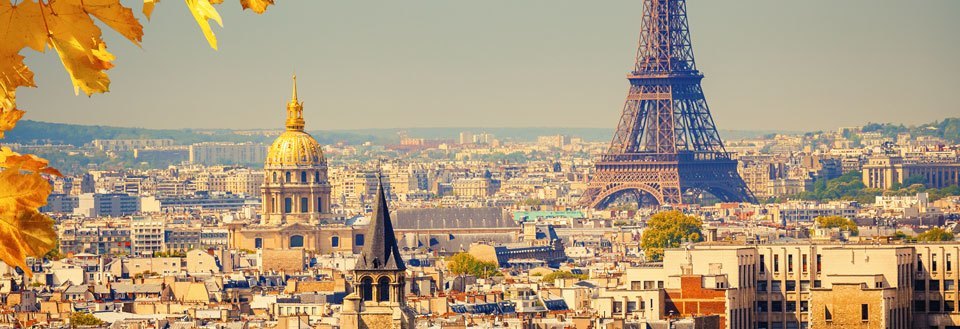
Each and every region in France is unique. France is an idyll of the Alps, the lazy life of the Riveria, the battlegrounds of the North; and the cosmopolitan and sophisticated atmosphere of Paris.
La France
Paris
547.30 km2
French
The country is mainly Catholic with 90 % belonging to the Roman Catholic Church. Other major religions include: Protestant (2%), Judaism (1%) and Islam (1%).
58.978.172 (September 2000)
Republic
The landscape in the largest country in Western Europe varies from region to region. Snow can always be found at the largest mountain in Europe, which is situated not many hours drive from the deep blue sea of the Rivera. In the south you find fields of lavender and valleys with olives. In the north you find a landscape resembling that of Northern European countries - with the exception of the many wine-fields that cover wide swathes of France. Broad rivers also wind across the French landscape from north to south.
France has a temperate climate with hot summers and cool winters. The temperatures can swing substantially from region to region. In general the mild Mediterranean is on average 10 degrees Celsius hotter than the rest of the country and seldom has any frost.
Lonely Planet France
1 French Franc = 100 centimes
You can easily locate an Internet café in cities with a population over a couple of thousand inhabitants.
Police (17)
The Fire Brigade (18)
An Ambulance (15)
Tips are included in the prices in France but you are still expected to tip some more. Normally you tip around 10 percent at good restaurants. At cafés you give a little change. The maid at the hotel, the piccolo, the porter and the hairdresser also expects to receive perhaps a franc.
The time in France is GMT + 1 hour
Weight: kilograms
Temperature: Celsius
Distances: kilometres
Cubic content: litres
While it is not advisable to take pictures of military installations you can take pictures almost everywhere in France. However, it is a good idea to be polite and to ask for permission if you wish to take pictures of the locals.
You can drink the water from all public wells in France. But if you are in the countryside and the wells are private you will have to be more careful.
In France you use 220 volt AC 50 Hz. For hair dryers e.g. you need an adaptor.
The French normally shakes hands with strangers while the famous kisses on the cheeks are exchanged between women who know each other, men and women, and adults and kids (just about everyone).
The banks are open from 9.00 to 16.00
The shops are open from 9.30 to 18.30 and quite a few are closed for a couple of hours around lunch.
The French kitchen requires little introduction - the wines and gastronomy are world famous. All regions have their own special dishes - from the German inspired dishes in Alsace to the famous Fish soup Bouillabaise in the South. Apart from the traditional French kitchen France is also influenced through the impulses of the old French colonies in Africa, as well as the cuisine of Italy and Spain.
To a certain degree the French take the needs of handicapped people into consideration. The needs of wheelchair users have been taken into account at a good deal of France's hotels and sights. However, it is generally a good idea to ask in advance if you need special facilities.
Bank Holidays
New Years day 1st of January
VE day, 8th of May
The Bastille day, 14th of July
Assumption, 15th of August
Halloween, 1st November
Christmas Day, 25th of December
Bank Holidays
New Years day 1st of January
VE day, 8th of May
The Bastille day, 14th of July
Assumption, 15th of August
Halloween, 1st November
Christmas Day, 25th of December
Bank Holidays
New Years day 1st of January
VE day, 8th of May
The Bastille day, 14th of July
Assumption, 15th of August
Halloween, 1st November
Christmas Day, 25th of December
Bank Holidays
New Years day 1st of January
VE day, 8th of May
The Bastille day, 14th of July
Assumption, 15th of August
Halloween, 1st November
Christmas Day, 25th of December
There are a lot of camping places in France so it is a good country to visit if you like an active outdoors holiday. All the places are separated into categories and the prices varies depending on the time of year and location.
Hotels in France lie within the range of one to four stars. There are plenty hotels and usually they are easy to locate. There are hotels to suit every taste - whether you want cheap hotels with a toilet and bathroom in the hallway, or luxurious suites. You can also try staying at a castle in the wine regions.
If you like something more local than the standard hotel chains you will be able to find plenty of B&B places in France. They are categorized in the same manner as the hotels with one to four stars.
In cities of medium size you will normally be able to find a hostel. France has several hundred of them - but in order to use them you need a membership card. This card can be bought at tourist information - or at the hostels. A system of 1-3 pines makes it easy for you to see what standard the hostel is.
Whether your aim is to go skiing, lie on the beach, or to explore the vineyards - you can also book summer houses, cabins and similar all around the country.
The international Air France runs a domestic company called Air Inter. Air Inter has departures between 31 different airports in France.
Most buses drive between the main cities in the regions but the intensity of this coverage varies a lot from region to region. If you wish to find information about departures and destinations your best bet is to look at the local bus stand. Even the tiniest cities as a general rule have regular departures out of town. In most urban areas you will find buses driving through the centre.
The national rail in France is called SNCF. SNCF covers most of the country. The famous TGV trains, which travel up to 320-km pr hour - connect 120 of the largest French towns. However most people use the more slow regional trains, which run regularly and on schedule.
There are many taxis in France and it is fairly easy to hire one on the street. In France you pay for luggage stored in the boot. The rates for the journey are written inside the doors in the back. The are different prices for driving day or night.
Renting a car in France can be quite expensive. Therefore, if you know you will need a car in France you can save lot of money by booking the car in advance from home. As a general rule you will have to be 21 years old to rent a car but some companies might have stricter rules. All the major car rental companies are located in France and have offices in middle size towns. If you drive a car in Paris beware that it is not allowed to honk the horn unless in case of emergency.
Ferries to Corsica and the larger islands off the Atlantic Coast go from Nice and Marseille. You can also explore many of France's beautiful areas by sailing on one of France's many rivers. The more than 9000 kilometres of rivers can be explored from a rented houseboat or a canoe - just to mention a couple of methods.
In many places in the countryside you can rent bicycles.