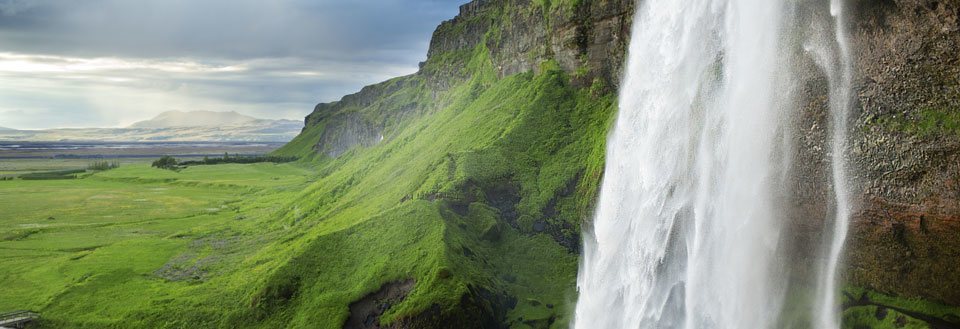
The rocky island of Iceland is situated in the middle of the North Atlantic Ocean, midway between Europe and America. It is well worth a visit - an island of unique natural wonders as well as vibrant local culture and history.
Lýdveldid Ísland
Reykjavik (102,000)
103,000 sq km
Icelandic
Evangelical Lutheran
265.000
Republic
Iceland was borne of volcanic activity, and rugged rocky landscapes and several great volcanoes characterize the island. Yet the island is also full of green valleys, great waterfalls, huge glaciers and hot, roaring geysers. More than half of the population is situated in and around Reykjavik.
Iceland benefits from the warm waters of the Gulf Stream, which is why the short summers are generally pretty mild. During the summer there are two or three months of almost constant daylight - and of course the sun only appears for two or three hours a day during winter, from November to January. Winter in Iceland is also characterized by a number of violent storms. The main tourist period stretches from June to September - when the entire island is open.
Króna (K)
To call for help in Iceland, dial the following numbers:
Police, ambulance and fire department (112)
Iceland's lifeboat service (56 86 068)
Tips are generally not expected in Iceland.
When it is 12.00 in Denmark (summer time), it is 10.00 in Iceland.
When it is 12.00 in Denmark (winter time), it is 11.00 in Iceland.
Following units of measurement are used in Iceland:
Weight: kilogram.
Length: meter.
Volume: litre.
Show common courtesy and always ask before taking photographs
It's safe to drink the tap water in Iceland - in fact, the Icelandic water is some of the world's purest.
Following current is used in Iceland:
220V AC, 50 Hz.
The rules for visitors of the Icelandic national parks are very strict. Because of the scalding hazard, walking outside of the marked trails in the geyser areas is prohibited, just as tossing dirt (rocks etc.) in the springs is. Apart from this - common courtesy and respect for the local inhabitants will get you far.
Banks are open 9.15-16.00 (Monday to Friday).
Shops are open 10.00-21.00 (Monday to Friday) and 10.00-19.00 (Saturday-Sunday).
Offices are open 9.00-17.00 (Monday to Friday).
Not surprisingly, fish, lambs and sheep dominate Icelandic cuisine. These three creatures end up a part of many dishes and are killed and cooked in a variety of ways. Icelandic schnapps, also known as "The Black Death", is one of the drinks worth mentioning.
New Year's Day, 1 January.
Labor Day, 1 May.
Independence Day, 17 June.
Christmas, 24-26 December.
New Year's Eve, 31 December.
Iceland has lots of camping sites, but most of them only have the most necessary facilities. Generally speaking, you can pitch a tent everywhere in Iceland, except the national parks.
There are only a few luxury hotels in Iceland, and they're all situated in Reykjavik. Hotels aren't classified in Iceland, but most of them have good, clean rooms with shower, telephone and TV. Book well in advance.
Iceland holds quite a few hostels with both single and family rooms, but it is advisable to book in advance.
Private accommodation for the most part takes place on farms.
As a major part of the domestic transport is by air, the country has, beside Reykjavik's large airport, some 50 smaller landing strips around Iceland. Air Iceland and Íslandsflug are responsible for the flights.
During the summertime, Iceland's buses connect practically the entire country, and it isn't very expensive either. The number of routes drops drastically during wintertime, though.
There is no railway in Iceland.
There are some taxis in the major cities, but it isn't a very cheap form of transport. In the smaller towns, it is often possible to get a ride by asking around in shops, gas stations, etc.
As bringing your own car is quite expensive, there are a lot of car rental companies around the country.
There are ferries between most of Iceland's ports during summertime.
The Icelandic road system functions impeccably during the summer, but the road surface often consists of grit. During the winter several thousand kilometres of road are closed off because of violent weather conditions.