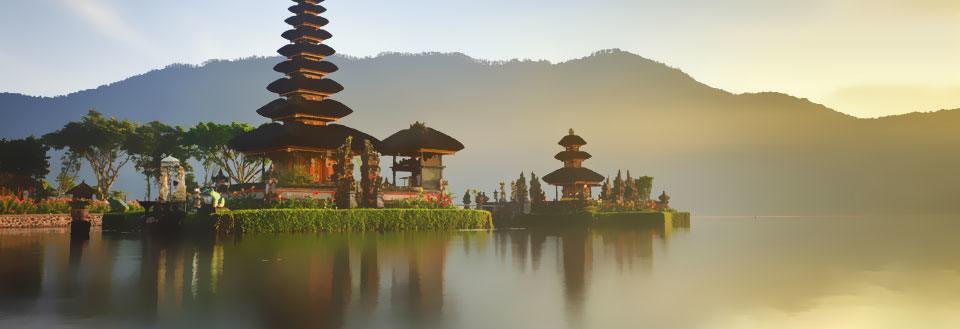
Hvadenten du er til tropiske hvide strande, enestående kogekunst, stammefolk fra en anden tidsalder eller et møde med de enestående orangutanger finder du det i Indonesien. Verdens største ørige byder også på maleriske risterasser, imponerende templer og meget meget mere.
Republik Indonesia
Jakarta (9,341,400)
1,919,440 sq km
Bahasa Indonesia
Also English, Dutch (among the elders) and a variety of dialects, of which Javanese is the most common.
Islam - 88% of the population are Muslim.
Moreover, there are Christians (8%), Hindu (2%, primarily in Bali), Buddhists (1%) and several minorities (1%).
224,784,210 (July 2000)
Republic
Indonesia is a huge country (almost 45 times the size of Denmark) situated in Southeast Asia - north of the Australian continent. It consists of six main islands: Sumatra, Java, Sulawesi, Bali, Kalimantan (the Indonesian part of Borneo) and Irian Jaya (the western part of huge New Guinea). In addition to this there are a multitude of smaller islands - in fact, there are more than 17,000, of which about 6000 are inhabited - which makes Indonesia the world's largest island state. The country has a tropical climate and is situated in a volcanic zone with more than 300 volcanoes, of which most are fortunately extinct.
In general the best time to visit is in the dry season between May and October. During this period it is still very warm, but as the heat is chiefly dry it is more pleasant. There can be many tourists around Christmas as well as during the European summer holidays, and the prices often rise during "Ramadan" which takes place at a different time each year.
Lonely Planet Indonesia
Lonely Planet Bali & Lombok
Bali & Lombok: The Rough Guide
Lonely Planet Java
Rupiah (RP)
Indonesia has kept pace with the 'information society', which means that the country has a fairly decent number of Internet cafés - primarily in the larger cities and at the tourist centres. Be aware that prices and quality vary greatly - so shop around.
To call for help in Indonesia, dial the following numbers:
Police (110)
Fire department (113)
Ambulance (118)
Tips are becoming more common in Indonesia, and taxi drivers, waiters and barbers expect 500-1000 rp. Major hotels demand payment of a 15% "service charge" for lodging, bar and restaurant bills. On top of that there's an 11% official "government tax".
When it is 12.00 in UK, it is 19.00 in Indonesia (Jakarta). (Summer time)
When it is 12.00 in UK, it is 20.00 in Indonesia (Jakarta). (Winter time)
The following units of measurement are used in Indonesia:
Length: metre.
Weight: kilo
Temperature: centigrade.
Indonesia is a place where photo-opportunities exist around every corner and the light is formidable - it is a paradise for photography enthusiasts. Photography is more than welcome everywhere, but keep the camera far away from military installations, and show respect at temples, during ceremonies etc. Always ask for permission before taking snaps of individuals.
Do NOT drink the tap water, but buy bottled water, which is available everywhere and is very cheap.
Following source of electricity are used in Indonesia:
220 Volt AC/50 Hz.
Some places still have sockets with 110 Volt. In rural districts the power supply can be unreliable and lead to power failures, so remember the flashlight.
When abroad you represent your own country, so offensive behaviour should be avoided. Be polite, and cover your legs and arms and take off your shoes when visiting mosques and temples.
The banks are open 8-16 all weekdays and a few are open 8-12 on Saturdays.
Shops are open 9-17, Monday to Saturday.
Offices are open 8-16, Monday to Friday.
Indonesian cuisine has been inspired and influenced by China, India, the Middle East and even Europe over the years. The result of this is a unique cuisine with a lot to offer. Lemongrass, coconut, cardamom and saffron are widely used - some dishes are hot, most are not. Some of the dishes you can find everywhere are fried rice (Nasi Goreng) and fried noodles (Mee Goreng). There is also Satay, which is small pieces of flesh grilled on tiny skewers of wood and served with a peanut sauce. On the other hand there are also less exotic western dishes and fast food in the tourist areas. Soda water, mineral waters and beer are available everywhere. Bintang is a decent Indonesian beer - it readily competes with the imported brand beers.
Facilities for disabled people are substandard throughout the country. Only the major hotels provide facilities for disabled people - so you should check with your travel agency to ensure that ramps for wheelchairs, suitable bathroom facilities and suchike will be present.
There are three fixed holidays in Indonesia:
New Year's day, 1 January.
The Indonesian Day of Independence, 17 August.
Christmas Day, 25 December.
Shifting holidays:
Eid al-Fitr, end of the Ramadan.
Nyepi, March.
Good Friday, March or April:
Ascension Day, mostly in May.
The Islamic New Year.
Waisak, May or June.
Indonesia has several camping sites, although rarely used by tourists, as living in hotels or a losmen (guest house) is so cheap.
Hotels, along with beach resorts, are some the most expensive possibilities for accommodation in Indonesia, but there are also considerable differences in price in this category. Standard hotels are evaluated by the so-called melati jasmine system, while luxury hotels are rated by a different system, the so-called bintang system.
There are three different categories, with the penginapan as the most simple. The losmen are somewhat better and very popular among backpackers. Finally the wisma is the best, but also the most expensive, and often include breakfast and a toilet with flush.
The Indonesian Garuda Airlines takes care of most of the domestic flights and makes it easier to explore this vast country. Particularly if you don't have much time in Indonesia, consider taking a few domestic flights. Merpati Nusantara Airlines flies some of the distances as well.
Bus connections are available everywhere, but are best for trips of short duration. For longer trips you should take the train, as they're a both better and safer alternative. The buses are often crowded and can be a dangerous - at best a thrilling - experience. In the cities the ways of transport are many, such as the three-wheeled bemo, which is considered a taxi for poor people, or an oplet - a kind of shared taxi, picking up people along a certain route. Bemo-drivers often have a tendency of wanting to "earn a little extra" on tourists, so check the right price with the local passengers!
The train system on Java covers 6,458 km, and is an excellent way of getting from A to B. It isn't always very fast, but it is safe and fairly comfortable.
There are lots or taxis in the cities, but be sure that the meter is on or agree on the price before the ride. Don't be afraid to bargain (thoroughly) about the price!
If you want to transport yourself around, car rental is available from the international hire companies in Jakarta and Bali. Remember an international driving license from your local police station!
There are naturally lots of ferries between the many island which can be crowded and aren't very comfortable, but cheap.
Motorcycles are popular and can be rented practically everywhere. These practical vehicles are particularly convenient for your own private tour of Bali and Java, but many tourists are injured each year in the Indonesian traffic. Be careful and remember that you're on holiday!
Unfortunately there has been a lot of domestic unrest in Indonesia for quite some time now - nevertheless large parts of Indonesia seem to be relatively safe for tourists. However, trips to the Molucca provinces including Ambon and Irian Jaya, the Aceh province in northern Sumatra, West Timor and the town Poso along with the surrounding area in central Sulawesi are not recommended. Check with current Foreign Office guidelines to be on the safe side.