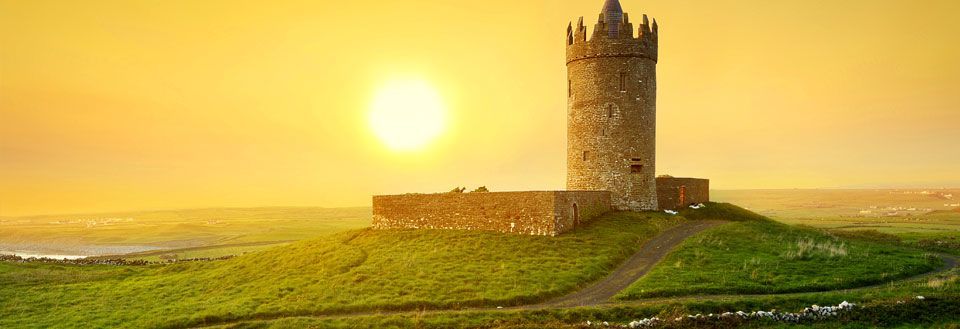
The 'Emerald Isle' earned its name due to the green colours that dominate the scenery. Ireland is a highly hospitable country with a wonderful distinctive culture. Once you have visited Ireland you really will never be able to forget it.
Ireland
Dublin (477.675)
70.282 km2
Irish and English
Catholicism
3.797.257 (2000)
Republic
Ireland is situated in the northern part of the Atlantic Ocean and is separated from the British mainland by the Irish Sea to the east. The eastern coastline is blessed with sandy beaches, semi-tropical bays and angular rocks - and on the ground a mild climate makes the soil green and fertile.
If you wish to experience the great national festival of the Irish, St. Patrick's day, you should go there around 17 March. Otherwise it is best to visit Ireland in the summer months - when nature is blooming and most activities take place.
Lonely Planet Ireland
1 Irish pound (IEP) = 100 pence
It is not hard to find an Internet café in Ireland. All the big cities have one or several of them.
To call for help in Ireland you must dial the following number:
Police, fire department and ambulance (999).
At hotels and restaurants tips are included in the price, but it is good custom to round up a bit.
When the time is 12.00 in England, it is 12.00 in Ireland as well.
In Ireland you use the following units of weight and measurement:
Length: yard, mile
Weight: pound, stone
Liquid: pint, gallon
Photography is not allowed in churches. Unless otherwise indicated, you can take pictures as much as you want everywhere else.
It is safe to drink water from the tap.
In Ireland they use the following current:
220 V, 50 Hz
Banks are open from 10.00 till 12.30 in the morning and from 13.30 till 15.00 in the afternoon (Monday till Friday). On Thursdays banks are open till 17.00 in Dublin. Shops are open from 9.00 till 17.30 (Monday till Saturday). Some cities have "half day", which means that the shops close around noon one day a week. This is not the case in Dublin, though.
The post office is open from 9.00 till 17.30 (Monday till Friday) and from 9.00 till 13.00 on Saturdays.
The fact that Ireland is an agricultural country surrounded by water is reflected in most of the cuisine. The meals typically consist of flesh from the farm animals - or creatures from the many rivers and oceans that surround Ireland. There is no getting away from the fact that Ireland is the home of pubs. People meet there after working hours and release their joys and sorrows with friends and acquaintances.
Information about faciities for the disabled in hotels, restaurants and at tourist sights can be obtained at the National Rehabilitation Board, 25 Clyde Road, Ballsbridge, Dublin 4.
New Years Day, 1 January
St. Patrick's Day (National Day), 17 March
Christmas Day, 25 December
St. Stephen's Day, 26 December
Holidays that are not fixed on a certain date
Good Friday
Easter Monday
First Monday of May: holiday
First Monday of June: holiday
First Monday of August: holiday
All Saints weekend, last Monday of October.
Ireland has both caravan parks, aimed solely for caravans, and camping and caravan parks aimed for both caravans and tents. The camping grounds have been given between zero and four stars depending on their standard. Most are open during the summer half of the year.
There are over 668 hotels all over Ireland, which have been both judged and approved by the Irish Tourism Board. Furthermore, the prices have been standardized according to how many stars the hotel has.
The Irish Tourism Board has registered 209 guesthouses. They are smaller and more intimate than the hotels and are very often administered by private families. You can choose between guest houses which offer only bed & breakfast or guest houses which offer up to full pension.
There are two competing hostel chains, namely Youth Hostels and Independent Hostels. Youth hostels demand a member card and they are run by the Irish Youth Hostels Association. Independent Hostels is a private co-operation, which have several hostels approved by the Irish Tourism Board.
It is also possible to live at farm houses, town houses, country homes, pensions and accommodation with self-catering.
There are several flight connections between the major cities. There are flight connections from Dublin to Cork, Shannon, Galway, Knock, Sligo, Carrickfinn and Kerry.
Ireland has everything from nation-wide bus routes to local bus networks and airport services.
The Irish Railway, Iarnród Éireann, has train connections between all major cities. It is possible to bring your bike on many of the trains.
Only the large cities Dublin, Cork, Galway and Limerick have taxies with taximeters. In other cities taxies do not have taximeters so you have to settle a price with the chauffeur before starting the trip.
It is easy to rent a car in Ireland and even easier if you order the car through your travel agency before departure. In order to rent a car in Ireland you must have had your license for at least two years, and you must be at least 23 years old. The minimum age varies from place to place, though.
There are ferry services from Ireland to neighbouring countries. By the West Coast of Ireland there are a number of charming islands, which are of course connected to the mainland regularly by ferries.
The friendly Irish do not mind having a stranger in their car. In other words, the possibilities for hitchhiking are good - provided you avoid the most touristy and densely populated areas.
If you have just been robbed and wish to get in contact with a policeman on patrol, it is no use shouting "police" at the person. You should shout "Gardee" instead, since this is the Irish name for police.