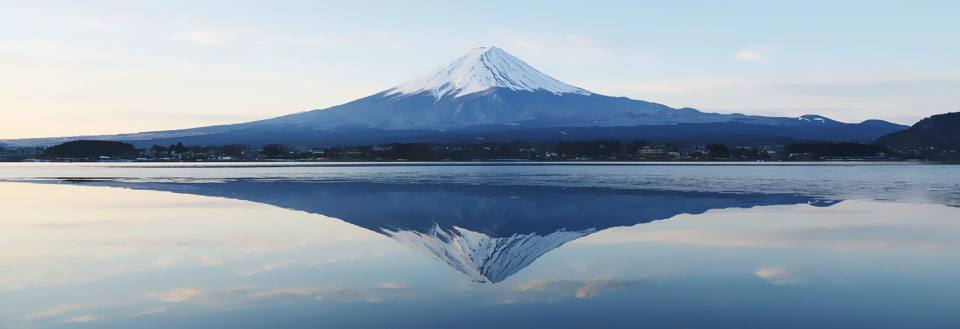
Japan has just about everything - colourful history and culture, fabulous natural scenery and enthrallng big cities. The possibilities are diverse and endless - from trendsetting architecture and design to mountainous landscapes, from sumo wrestling to sushi, and from bonsai to karaoke.
Nippon
Tokyo (12.000.000)
377829 km2
Japanese
Shintoism and Buddhism
126.965.000 (1997)
Constitutional Monarchy
Japan is filled with mountains and possesses more than 40 active volcanoes. The largest of Japan's 4 main islands is Honshu Island. It is a densely populated island which is also known as 'the mainland' - and it is where Japanese industry is concentrated. In major contrast to Honshu Island is the second major island of Hokkaido. Hokkaido is found to the north and it possesses far fewer residents and some wide areas of beautiful natural scenery.
Japan can be visited all year around. In spring and autumn the mild weather and the changing natural colours are perfect for enjoying a fabulous cycling adventure. The summer offers great scuba diving and snorkelling opportunites. You can also go skiing in Japan during winter and spring. In short, Japan can be visited at any time. However, do be aware that Japan suffers a lot of rain in June and early July. - and in the north the winter is very cold.
Yen (Y)
Both large cities and smaller towns in Japan have internet cafés, so it should be fairly easy to find one. At the same time Internet cafés are less common than you might actually expect - because most Japanese own their own computers!
If you need help you should call the following numbers
The Fire Department and ambulance (119)
Police (110)
You can also go the nearest Police Box (Koban) on the street.
If you need a doctor or an ambulance and don't speak Japanese the easiest way to get help is to call Tokyo English Lifeline ((03) 3403-7106)
In Japan tips are seen as insulting - therefore do refrain from giving any. If you wish to thank for an especially good service at an hotel - or perhaps for some help you received, then simply send a postcard from your next destination - or give a present very discreetly when you are leaving..
When the time is 12.00 in England (summertime) it is 20.00 in Japan
When the time is 12.00 in England (wintertime) it is 21.00 in Japan
In Japan you use the following weights and measurements
Weight: kilo
Length: metres
: Be polite and always ask for permission before taking a picture
The tap water is clean almost everywhere in Japan. However, if you are in a big city, it is recommended to drink bottle water.
In Tokyo and the eastern parts of Japan you use
100 volt AC, 50 Hz.
In the western parts of Japan (Osaka) you use
100 volt AC, 60 Hz.
The Japanese don't expect tourists to be familiar with Japanese etiquette - you will get far just by showing courtesy. The Japanese don't shake hands, but bow when greeting and saying goodbye. Presents are an important part of social behaviour in Japan. When visiting somebody for the first time you should therefore remember to bring a present. When introducing somebody you should always mention his or her last name first. Very personal remarks and irony are not considered good manners. You should also always remember to take your shoes off when visiting private homes and Buddhist temples.
Banks are open from 9.00 to 15.00 (Monday-Friday) and from 9.00 to 12.00 (Saturday)
Offices are open from 9.00 to 15.00 (Monday-Friday) and from 9.00-12.00 (Saturday. The offices are closed the second Saturday in the month)
Shops are open from 10.00 to 20.00 (Monday-Sunday)
The Japanese kitchen is strongly influenced by Zen Buddhism. The basic insight is that food should not only satisfy your body but also your mind. The Japanese kitchen welcomes you to a world full of diverse and exotic food. Dishes are mainly composed of fish, seafood, seaweed and rice. As animal flesh is expensive in Japan then dishes containing it are rare. Japanese cuisine also offers a wide selection of interesting refreshments, and perhaps unmissable is the famous traditional tea ceremony.
New Year's Day 1st of January
Day of Young Adults 10th of January
Nation's Foundation 11th of February
Spring Equinox 20th of March
Nature Day 29th of April
May Day 1st of may
Constitution Day 3rd of May
Holiday the 4th of May
Children's Day 5th of May
Day of the Sea 20th of July
Senior Citizen's Day 15th of September
Fall Equinox 22the of September
Sport's Day 9th of October
Culture's Day the 3rd of November
Labour's day 23rd of November
Emperor's Birthday, National Day 23rd of December
It is very hard to find places for camping in Japan - there only are a few camp-sites.
The hotels in Japan (including the Ryokans) can be very expensive. Hotels are divided into 3 categories, and it often makes sense to spend the night at a hotel for business people, as they are usually reasonably priced.
In Japan you can find guesthouses called Kokumin shukusha in the most fabulous scenarios. The prices are similar to that of a business hotel. Private boarding houses are cheaper but usually have no showers.
Japanese hostels can be used by all regardless of their age. To stay at a hostel you have to book in advance and stay for a maximum of 3 nights.
If you are claustrophobic don't try a cabin hotel - the rooms are the size of the bed. Cabin hotels are cheap, but for men only. You can also reserve a night at some temples called Shukubo through the local tourist office.
If you are in a hurry it is a good idea to travel by plane. Several large airline companies have routes to most of the larger cities
Train is a highly efficient way to travel around in Japan. If you buy a Japan Rail Pass you can save a lot of money.
In the larger cities taxi drivers often have problems finding a specific address. Therefore it is a good idea to mention the nearest Underground station when booking a taxi.
If you want to rent a car you will need an international driver's license. In general it is best to avoid driving on your own in Japan - it is impractical, complicated and expensive.
Several companies connect Japan's many islands. The long travel time is by far compensated by the beautiful scenery you will encounter on your journey.
Weak and short earthquakes are common in Japan. Typhoons are also common in late summer, especially in the southwestern parts of Japan.