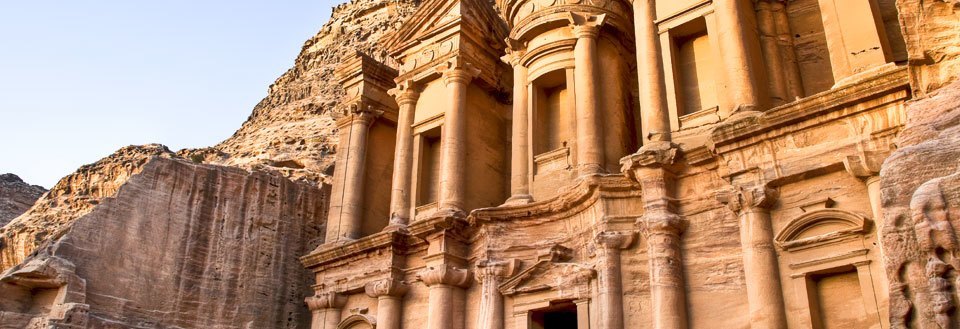
Jordan is a desert land rich with fabulous potential experiences for all travellers. The Jordanian desert is a fascinating place to explore for ancient cities once hidden in the sand.
al-Mamlaka al-Urdunia al-Hashemiyah
Amman
89,206 sq km
Arabic
Islam
5,200,000
Monarchy
Jordan is chiefly covered by sand; in fact 80 per cent of the country is desert. The remaining 20 per cent is mainly located around the Jordan River, where the main part of the population lives in the country's most fertile lands.
The weather in Jordan follows the same pattern as the rest of the Middle East - with warm summers and cooler winters. The summer temperature in Jordan can sometimes reach 49°C, but this is thankfully quite rare. During the winter a little snow is not unusual, and if you want avoid both extremes of summer heat and winter snow, then you should visit Jordan during the spring or the autumn.
Lonely Planet Jordan
Jordanian Dinars (JD)
Finding an Internet café in Amman is not a problem as many hostels and cafés have computers. It will get a bit more difficult if you are going to the smaller and more remote towns, but with a little patience you should be able to find one.
In case of an emergency in Jordan, call the following numbers:
Police (192), (462).
Ambulance and fire department (193).
In the more exclusive restaurants, waiters expect a ten per cent tip, but otherwise tipping shouldn't be necessary.
When it is 12.00 in England, it is 14.00 in Jordan
Following units of measurement are used in Jordan:
Weight: kilogram
Length: metre
The Jordanians are, generally speaking, very friendly and forthcoming - so taking snaps should not be a problem, as least as long as you show general politeness and respect towards them.
It is best to buy your water in bottles here. The Jordanians have recently had a problem with water poisoning, which has led to the request that everybody boil their water before use. If you limit your use of tapwater to brushing your teeth, then you should not experience any problems.
In Jordan, the following current is used:
220 volts AC, 50Hz
There are no specific rules of conduct, except in the mosques, where you should dress in clothes that cover your entire body.
Shops are open 9.00-13.00 and 15.00-20.30 (Saturday-Thursday).
Offices are open 9.00-18.00 (Saturday, Wednesday-Thursday). Some offices have a couple of hours' lunch break.
The Jordanians enjoy Arabic cuisine, with well-known dishes like falafels, shawarma and hummus, and the different variations of these. A Jordanian speciality, from the bedouin minority in the country, is mensaf, which is spiced lambflesh cooked and served with rice. It is served with the head and, for those who are particularly lucky - the eyes still looking at them. The second-luckiest person will get the (now silent) tongue.
Unfortunately, Jordan is not the best place to go for a disabled person, as many of the sights are ruins surrounded by sand and rocks - not very wheelchair or crutch-friendly. Whether or not a trip to Jordan will be successful really depends on your relative mobility, and unfortunately on your patience.
In addition to the regular Muslim holidays, the Jordanians have a few local holidays:
Independence from the Ottoman rule, 25 May.
The Anniversary of the Great Arabic Rising 10 June.
You can indeed camp in some parts of the desert, but there are no camping sites around Amman.
There are plenty of hotels, from the small independent ones in the sidestreets, to the large international chains like SAS-Radisson and Marriot. Price and quality usually imply each other.
The only domestic route is the daily flight between Amman and Aqaba which is flown by a subsidiary company of the national airline Royal Jordan. Note that the flight is not from the international airport, but the smaller Marka airport.
The national bus company Jett operates a number of domestic routes criss-crossing Jordan, as well as a few international routes, among others to Baghdad, Jeddah and Riyadh. The buses are cheap, but not very fast, and it can be difficult get a seat.
The only train connection in Jordan is between Amman and Damascus, but is not very regular. In neither Jordan nor Syria are the train stations found anywhere near the capital city-centres.
The minibuses of the Middle East are naturally also a success in Jordan, and because they are fast, cheap and regular they are a great alternative to the buses. There are also normal taxis, but as in so many other places in the world, the country's greatest conmen are either in prison or behind the steering wheel of a taxi. Make sure the taxi-meter is on, and if the driver refuses, then do get out and find another taxi. If you are going far - and even on shorter distances - you should agree on a price in advance. This also gives your driver an incentive to take the shortest route - an option which is less encouraged by the ticking of a meter.
The local car-rental companies are usually cheaper than the international ones that have found their way into Jordan. Often the only situation in which renting a car is advantageous is if you want to go and explore the desert on your own. For between the major cities and the border towns the minibuses or public transport are often faster and cheaper than any tourist behind their own wheel.
Jordan's only port Aqaba by the Red Sea has frequent connections to Nuweiba in Egypt. There are several options, which fit both a tight and a loose schedule, and the price will usually depend on how quickly you want to get there.
A number of international organisations accept volunteers who wish to help on archaeological excavations. It is normally unpaid work. Contact:
British institute at Amman for Archaeology & History
PO box 519
Al-Jubeiha, Amman
11941
Jordan
or
Institut Francais dArchéologie du Proche Orient
PO box 5348
Amman
Jordan