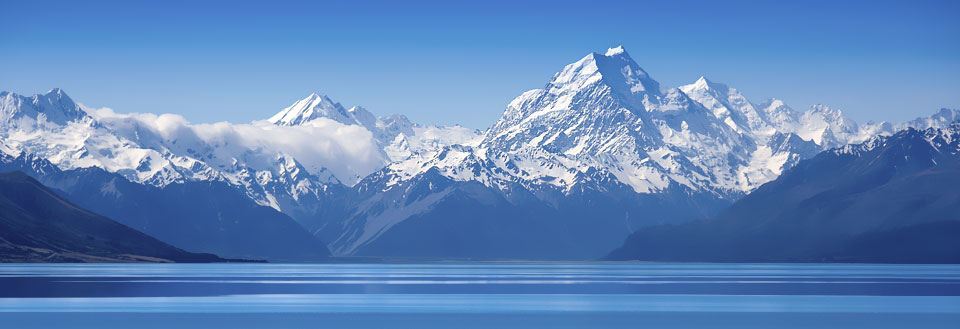
As far away from Europe as you can imagine is the country that the Maoris named Aotearoa, the Land of the Long White Cloud - known to us as New Zealand. It is so far that it doesn't matter whether you go east or west around the globe to get there. In spite of being located in the southern Pacific, halfway between the Equator and Antarctica, it is instantly recognisable as European in an old-fashioned but down-to-earth kind of a way. New Zealand is stitched together with one beautiful natural area after another - it is the country where you can find roaring rivers, mountains, glaciers, deep, clear rivers, large nature reserves and long, white beaches.
New Zealand, Aotearoa
Wellington (328,000)
266.171 sq km
English
Christianity
New Zealand has a total of 3,642,500 inhabitants, and thus a very low density of population. In contrast to this, the country has a total of 45 million sheep.
Constitutional Monarchy (member of the British Commonwealth)
New Zealand is located 1930 km south east of Australia, and consists mainly of two large islands, separated by the Cook Strait. The northern island has the warmest climate. Two thirds of the country is mountainous, as well as there being many rivers, deep lakes and large areas of tropical rainforest.
The weather in New Zealand is never really so poor that you will have nothing to do, so the country can be visited all year around. The most temperate months are from November to April, but the country also has many good skiing resorts to visit during the winter. The summer lasts from December to February, the autumn is from March to May, the winter from June to August and the spring season between September and November. There is also the strange rule - to Europeans anyway - that it is warmer in the north than in the south. The largest city, Auckland, has an average summer temperature of 23°C and 15°C in the winter, if you can truly call it winter with such temperatures. Northern New Zealand has no real winter.
Lonely Planet New Zealand
Fodors Exploring New Zealand
New Zealand Dollars (NZ$)
There are Internet cafés in all the larger cities in the country, and often several in each city.
To call for help in New Zealand, dial the following number:
Police, ambulance and fire department (111).
Tips are not expected, but giving a ten per cent tip for exceptionally good service is common.
When it is 12.00 in the UK (summer time), it is 22.00 in New Zealand.
When it is 12.00 in the UK (winter time), it is 24.00 in New Zealand. (They have summer when we have winter)
Following units of measurement are used in New Zealand:
Weight: kilogram.
Length: metre.
There are no special conventions concerning photography.
Drinking tapwater is no problem, and you can even find freshwater, reminding you of the real beauty of this primordeal beverage.
Following current is used in New Zealand:
230/240 volts AC, 50Hz.
There are no special rules of conduct, and if you see a man with countless frightening facial tattoos, then behave normally and greet one of the historically natural inhabitants - the Maoris.
Banks are open 9.00 -16.30 (Monday - Friday)
Shops are open 9.00 -17.00 (Monday - Friday), and 9.00 -14.00 (Saturday), some supermarkets are open 24 hours a day.
Offices are open 9.00 -17.00 (Monday - Friday).
Some of the dishes that the Maoris used to enjoy, and which you won't find on the menu today, were each other. Today New Zealand cuisine is diverse, but often stimulating and tasty, symbolic of the country's different cultures, and includes a wide range of dairy products, as well as many flesh dishes with beef, pork and lamb. The dishes also contain vegetables - such as the local kumara, a sweet potato. Also eaten are many types of seafood. One of the local favourites is a barbecue, which is served anywhere and anytime. When it comes to drinks, New Zealand produces both excellent beer and wine of different varieties, and which can usually be found in all regions. The Kiwis have a somewhat peculiar relationship with alcohol though, and on Sundays you can only get spirits to have with your meal. To buy alcohol you have to be demonstrably 20 years old, and even then it can prove difficult to buy a drink in a bar. Many restaurants do not serve alcohol at all, because of the paperwork involved in getting an alcohol permit, but encourage people to bring their own drinks with the sign BYO (Bring Your Own).
The facilities for disabled people have gradually become quite good, and most hotels and guesthouses have facilities for wheelchairs as well as disability-friendly bathrooms. As most means of transport are also disability-friendly too, getting around should be no problem.
New Year's Day, 1 January
The day after New Year's Day, 2 January
Waitangi Day, 6 February
ANZAC Day, 25 April, a commemoration of the people dead in WW1.
Christmas Day, 25 December
The day after Christmas Day, 26 December
New Zealand is said to have some of the most beautiful camping areas, and there are indeed many camping sites throughout the country, most of which have good facilities as well.
The country has both multiple-star hotels and cheap hotels - of which all are generally speaking in good condition - and it is as a rule more expensive to stay in the cities. There are also a large number of motels in the country.
There are a number of guesthouses throughout the country, usually situated in older buildings and offering rooms of medium quality - but the quality as a whole is quite high. Furthermore, a number of farms and private houses offer accommodation somewhat like B&B. Organisations in the country can arrange this.
You'll find both public youth hostels and privately owned hostels throughout New Zealand, and getting a room is normally not a problem. Most hostels are in good condition.
On the west coast a number of 'country pubs' offer cheap rooms, and this can be a charming way to spend the night.
There are domestic flights between all major cities in the country, which currently has 27 domestic airports. If you already know that you'll be travelling by air a lot, it might be a good idea to buy an "Air Pass", which gives you the right to unlimited travel by air on Air New Zealand's domestic routes, but you have to buy it before you go there. You can also use some of the smaller airlines, some of which have offers that are not only a flight, but also an experience. Mt. Cook Airlines, for example, has tours on the South Island, where you'll be flown higher than any ski lift reaches and offers some really great off-piste skiing.
There are regional bus systems which practically cover the entire country, but also private companies with high quality buses. The transport system concerning buses is very well developed in New Zealand, and there are virtually no places that you cannot reach by bus. The essential bus company for backpackers, 'The Kiwi Experience' is an overwhelming triumph, and also is an inexpensive transport experience - you can get on and off as you please throughout the country. The most expensive pass costs 450 NZD and covers both main islands. The Kiwi Experience is mostly used by young backpackers, whilst 'The Kiwi Bus Pass' has a larger network of routes and is used by different age-groups. The pass can be used on a considerable proportion of the major bus companies, on the railroad crossing the South Island, and for the ferry between Wellington and Picton. By buying the pass at home you can save up to 40 percent of the price in New Zealand.
New Zealand also has a well-developed railroad system, with more than 4000 km of railroad and covering almost the entire country. Travelling by train can be a great experience as some of the routes go through beautiful landscapes.
There are taxis in all cities, and they all drive with a taxi-meter so no bargaining is necessary.
All major cities in New Zealand have both international and local car rental companies. Driving, as with so many other things, has been influenced by the British way of doing things, so you can drive on the left hand side on the roads. Everybody in the car is required to wear seat belts, and being caught without wearing them will immediately result in a fine. You must be 21 years old and have a national driver's license to rent a car in New Zealand.
There are several daily departures between Wellington on North Island and Picton on South Island, and the crossing is a sight in itself. It lasts about three hours and offers many beautiful seaside sceneries. Getting your car across is expensive, and in the high season the crossing can be booked for months in advance. The Price per person is 44 NZD, and 160 NZD for a car.
Phone: 0064 0800 658 999.
Instead of renting a car, you could also buy one. It's an investment, but with a little consideration and luck it can prove to be less expensive than renting. The region of Canterbury on South Island has the highest car prices in the country, so that is where you'd want to sell the car again. Northland and the Nelson area have some of the best prices.
Besides this, New Zealand also has the reputation of being one of the safest places in the world for hitchhikers, but unfortunately you'll often have to wait quite a while for a ride, because of the country's small population and the resulting lack of traffic.