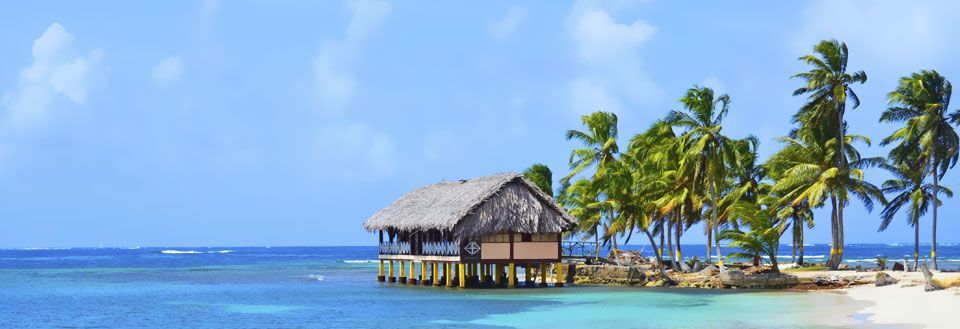
Panama is the country which connects South and Central America. It is an extended, thin country with long stretches of coast - meaning that Panama offers some of the best snorkeling and deep-sea fishing in the world. A beautiful country which is also a true cultural treasure.
Panama
Panama City (766.405)
75.517 square kilometres
Spanish
Roman Catholic
2.719.000 (1997)
Republic
Panama joins South and Central America; the country borders Colombia and Costa Rica and has the Caribbean Sea to one side and the Pacific Ocean to the other. The landscape is highly mountanous - with great areas of lowland and rivers. The Pacific Ocean and the Caribbean Sea are famously connected by the Panama Canal.
The best time to visit Panama is the dry season from December to April. During the rainy season it can be very hot, not least because of the humidity.
Lonely Planet Panama
Lonely Planet Central America on a Shoestring
Inside Panama
Balboa (B)
There are a few internet cafés in Panama City but none yet in the rest of the country (2000).
For emergency calls in Panama dial:
Police (62 69 63)
Fire Department (103)
A 10-15 per cent tip at hotels and restaurants is normal.
When it is 12 noon in the UK (summer time), it is 6 am in Panama.
In Panama they use the metric system.
There are no specific rules of photographing
In Panama City and Colón it is possible to drink tapwater, but in the rest of the country it is wise to boil the water before use.
In Panama they use the following power source:
120 volt AC, 60Hz
There are no specific rules of conduct.
Shops are open from 8 am to 6 pm (Monday-Saturday).
Office hours are from 8 am to 12 noon and from 2 pm to 5 pm (Monday-Friday).
Banks are open from 8 am to 1.30 pm (Monday-Friday) and from 8.30 am to 12 noon (Saturdays).
French, Spanish and American food are served in all restaurants in Panama City and Colón, just as there are quite a few oriental restaurants. Traditional courses are usually hot and spicy. Fish and chicken-flesh together with lots of vegetables are very popular. Concerning drinks you can have everything that you heart desires - from beer to wines and spirits.
The conditions for disabled persons are not good in Panama. Very few buildings have facilities which makes it possible for a wheelchair to enter, just as most means of transport do not have wheelchair facilities.
New Years Day,1 January
Dia de los Tres Reyes Magos. 6 January
Martyrs Day, 9 January
Dia de los Maestros, 11 March
Labor Day, 1 May
Dia del Padre, 16 June
Anniversary of the Founding of Panama City, 15 August
Childrens Day, 1 November
All Souls Day, 2 November
Anniversary of Separation from Colombia, 3 November
Flag Day, 4 November
Anniversary of 1st Call for Independence in Los Santos, 10 November
Anniversary of Independence from Spain, 28 November
Mothers Day, 8 December
Christmas Day, 25 December
New Years Eve, 31 December
There are no public camping sites in Panama, but some places camping on the beach is permitted.
With time the country has come to offer a wide selection of hotels. And even more hotels are being built in the cities and in the rural districts. You can find everything from expensive international hotel chains to reasonable, private hotels.
There are several inns around the country which work like B&B or guest houses. Most inns are in good condition and are budget class.
There are no hostels that we know of. But instead there are quite a few boarding houses which actually works as a hostel. There are both small rooms with bath and toilet and larger dormitories with shared bath and toilet. Most boarding houses are moderate or budget class.
The options for international flights are good. There are several airports and the flying network is well-developed. Prices may vary, but are often reasonable
There is a bus service between almost all towns in the country. Buses are inexpensive, but also very slow, just as they are usually crammed.
There is a railway in Panama, but the trains usually carry freight and seldom passengers.
Taxis operate in all towns in the country. You can hail them in the street; none of them use fare-meters, so it is wise to agree on the price before leaving.
You can rent a car in all cities in the country. Note, however, that some places only rent out a car with a driver.
Quite a few boats operate in several parts of the country; boats and ferries operate in particular between the islands of San Blas and Bocas del Toro. It is also possible to travel by boat up the Panama Canal.