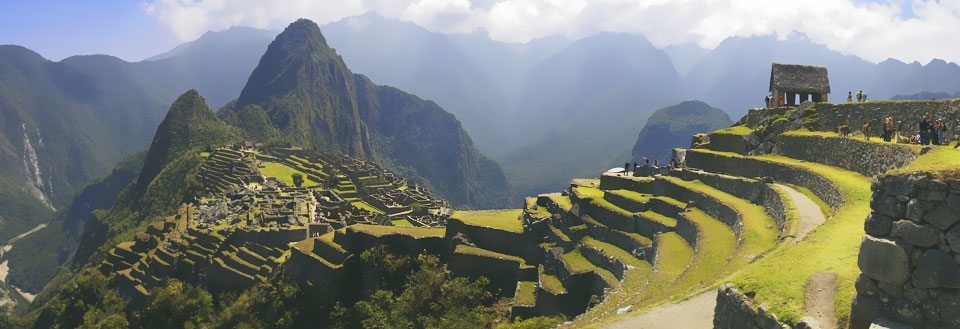
Several different cultures have left their mark on Peru. You can explore colonial cities and experience the Spanish heritage - or alternatively discover the capital of the Incas, Cuzco, where you can also experience the incredble lost city of Machu Picchu.
Republica del Peru
Lima (7,060,600)
1,285,216 km2
Spanish and Quechua
Roman Catholic
25,232,000 (1999)
Republic
Peru is, geographically speaking, divided into three zones. Vast areas of desert separated by fertile valleys cover the coastal region. The highland consists primarily of the Andes. The third region is subtropical and stretches from the Andes to the jungles of eastern Peru.
The highland of Peru can be visited all year around, but it can get rather wet during the rainy-season - from January to April. The peak season in this area is from June to August. The coastal region is most sunny from December to March, and somewhat chilly for the rest of the year. The rain falls all year around in the rainforests, but rarely more than a few hours a day, which means that this area can also be visited all year around. The heaviest rainfalls are from December to April.
Lonely Planet Peru
South America on a shoestring
Insight Guides Peru
Nuevo Sol (S/.)
All major cities in Peru have Internet cafes.
To call for help in Peru, dial the following numbers:
Police (105). Only in Lima.
Fire department (116). Only in Lima
In the rest of the country, call toll-free at (080042579).
You usually give 10-15 per cent in the expensive hotels and restaurants. Tips are not expected in the cheaper restaurants, but appreciated anyhow.
When it is 12.00 in the UK (summer time), it is 05.00 in Peru.
When it is 12.00 in the UK (winter time), it is 06.00 in Peru.
The following units of measurement are used in Peru:
Length: metre
Weight: kilogram
There are no specific rules concerning photographing, but the local Indians can be somewhat shy, so you should ask before taking their picture.
All water in Peru should be boiled before drinking.
The following current is used in Peru:
220V, 60Hz
There are no specific rules concerning behaviour, but you should be careful not to display your valuables, as there have been quite a lot of assaults in the country.
Banks are open 8.30 to 11.30 (Monday to Friday)
Shops are open 10.30 to 19.30 (Monday to Friday); many shops are also open during the weekend.
Offices are open 8.30 to 17.00 (Monday to Friday).
Peruvians are famous for their excellent cooking, usually with pepper and garlic as well as with a broad selection of other vegetables. By the coast there are many seafood and shellfish restaurants, and further inland they still cook an old Inca delicacy - fried guinea pig. All dishes are usually served with potatoes or rice. The most famous Peruvian drink is pisco sour - which is alcohol made from grapefruit, but you can also get good Peruvian beers and wines.
The facilities for disabled travellers are not good in Peru.
New Year's Day, 1. January
International Labour Day, 1 May
St. Peter and St. Paul, 29 June
Independence Day, 28 July, celebrated on 29 July
St. Rosa, 30 August
The battle at Angamos, 8 October
Halloween, 1 November
Conception Day, 8 December
Christmas Day, 25 December
There are no official camping sites in Peru.
The large international hotel chains are primarily located in Lima, but you can find a hotel in almost all cities, from 3-4-star hotels to cheaper, less luxurious hotels. The standard is generally quite good.
There are a good deal of hostels in the major towns, and it is usually not a problem getting a room. The prices vary, though, so you might want to check a few places before deciding.
Peru has a lot of domestic flights and a lot of airlines to choose from, so the prices vary a good deal. Many routes are fully booked during the tourist season, so you should book in advance. Also be prepared that the system doesn't always work, so you might have to wait sometimes.
There is bus service between most towns and cities in Peru, and even though it is a cheap way of getting around, you should also be aware that the standard is often quite bad and that it can be a testing way of getting around. Because of the long distances in Peru, the trips can take several hours.
There are trains from Arequipa to Juliaca and Puno and from Puno there's a train to Cuzco. Sometimes there is train service between other cities, but these are often closed during the winter, so you should remember to check this before deciding to get around by train. There have been a lot of thefts in the trains in Peru, and it is advised only to travel by train during the day.
There are taxis in all major towns. The yellow taxis are organized, but there are also many unlicensed taxis. These do not have taxi-meters installed, so you should agree on the price before getting in.
You can rent a car in airports or at larger hotels.
There's a ferry between Pucallpa and Iquitos that lasts five days. There is also boat service on Lake Titicaca, where you can also rent a smaller boat yourself.