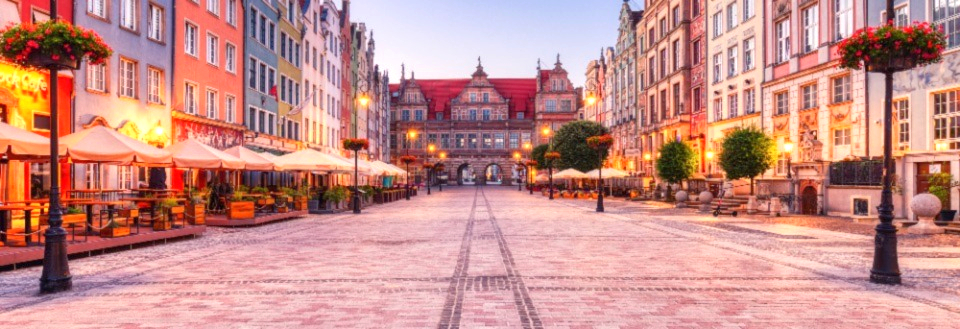
Poland has a lot to offer. Here you can find art, culture, music and beautiful scenery in a highly varied landscape. Apart from the big cities in Poland you can also explore charming little towns with a wealth of activities on offer.
Polska
Warsaw
312,683 square kilometres
Polish
Roman Catholic
38,646,023 (2000)
Republic
With its 500-kilometre stretch of coast, Poland borders the Baltic Sea in the north; Russia, Ukraine, Lithuania and Belarus in the east; and the Czech Republic and Slovakia in the south. West of Poland lies Germany.
The tourist season runs from May to September and peaks in July and August. If you wish to avoid too many tourists you should travel in the less busy parts of the tourist season. The cities are also worth a visit in winter time.
Lonely Planet Poland
1 polish zloty (Zl) = 100 groszy
There are relatively few internet cafés in Poland, and those who exist have rather slow connections. There are internet cafés in Warsaw, Krakow, Gdansk, Wroclaw, Torun and Zakopane.
For emergency calls in Poland call:
Police (997)
Fire Department (998)
Ambulance (999)
The Polish restaurants never refuse a good tip. In Poland you normally give a 10 per cent tip - this also goes for taxi drivers.
When it is 12 noon in the UK it is 12 noon in Poland.
In Poland they use the following weights and measures:
Distance: metric system
Weight: kilo
In Poland prohibition signs tells you where not to photograph. For instance photography is prohibited at the borders, military installations, bridges, railway stations, and air- and seaports.
In Poland they use the following power source:
220 volt, 50 Hz AC
Courtesy and old virtues still exist in Poland, where a man is likely to hold the door for a woman and kiss her hand when he takes his leave.
Food stores are open from early morning to 6, 7 or 8 pm. Note, however, that they close around noon on Saturdays.
Shops are open from 10 am to 6 pm. Opening hours are longer in Warsaw than in the rural districts.
Post offices are open 24 hours in the cities.
In Poland the most substantial meal is served between 3 and 6 pm. This meal often consists of potatoes and different kinds of flesh. Many people then have a small supper later in the evening, washed down with tea.
Only the newest hotels and tourist sights have facilities for disabled people. Apart from this Poland is a not really suitable for disabled people to travel in.
New Years Day, 1 January
May Day, 1 May
Constitution Day, 3 May
Assumption of the Blessed Virgin Mary, 15 August
All Saints Day, 1 November
Independence Day, 11 November
Christmas Day and 2nd Day of Christmas, 25 and 26 December
Moveable Public Holidays:
Easter
Corpus Christi: 10 days after Easter
Poland's many camping sites are a cheap option. Note, however, that the standard varies. The best sites are situated at the coast and in the cities.
The hotels in Poland are classified into five categories according to standard. The most expensive ones are the Orbis hotels, which are up to the standard of other Western luxury hotels.
The friendly Bed and Breakfast also exists in Poland. A similar and most popular choice is a farm holiday, which is also a very cheap solution. Just in the north-eastern part of Poland there are more than 100 offers of a farm holiday.
Hostels are the cheapest form of overnight accomodation in Poland and you'll find them in every part of the country.
The private boarding houses, which are scattered around the country, are a good alternative to the hotels. Furthermore it is possible to stay at castles and monasteries, which are being restored and converted to hotels several places in the country.
There are domestic flights between Warsaw and Gdansk, Krakow, Poznan, Szczecin and Wroclaw. The principal operator on the daily departures between the cities is the Polish airline company LOT.
Bus transport in Poland is mostly operated by the state-owned companies PKS and PPKS, but you can also travel with private bus companies. Bus tickets are about the same price as train tickets.
The Polish State Railway, PKP, offers some of the cheapest train travel in Europe. Moreover, the railway network is incredibly comprehensive, which means that you can reach even the smallest districts in Poland.
Every Polish taxi has a fare-meter, but make sure they are switched on when you leave. Very often tourists are charged too much - something you can avoid if you order a taxi at your hotel and inquire about the regular fares.
There are several car rental companies in all major cities, and the most expensive ones are the internationally known car rental companies. The Polish make, Polonez, is the cheapest car to rent; you have to be over 21 and have had a driver's licence for at least a year to be able to rent a car.
Ferries operate between the ports of Gdansk, Gdynia and Swinoujscie - all at the Baltic Sea. Here there are also ferry services to all of Scandinavia.