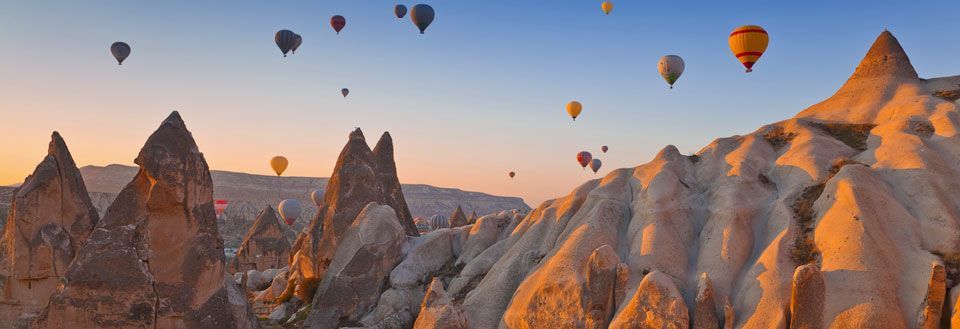
Turkey is an exciting mixture of Europe and the Middle East, and this combination is what makes the country such an attractive holiday destination. Turkey has a myriad of fascinating attractions, as well as plenty of activities on offer such as water-sports and mountain climbing.
Tûrkiye Cumhuriyeti
Ankara (2,890,025)
779,452 sq km
Turkish
Islam
64,567,000 (1999)
Republic
A large part of Turkey is mountainous country; with Ararat the tallest mountain. The western part of the country, Anatolia, consists of desert and there are actually many dry places in Turkey. The country borders up to Syria in the south, Iran in the east and Georgia and Armenia in the northeast. The Black Sea is in the north, whilst the southern and western coast borders with the Mediterranean Sea and the Aegean Sea.
The spring and the autumn are the best seasons to visit Turkey, as the climate by then is perfect by the Aegean and Mediterranean Sea, and it isn't too hot to visit Istanbul either. In the summer the country gets unbearably hot, and during the winter some parts of eastern Turkey become inaccessible because of snow on the roads.
Lonely Planet Turkey
Turkish lira (TL)
To call for help in Turkey, dial the following numbers:
Police (155)
Ambulance (112)
Fire department (110)
Tourist police in Istanbul (527-4503)
Tourist police in Ankara (134-1756)
Hotel staff, hairdressers, waiters and employees at the Turkish baths usually get 5 to 15 per cent in tips.
When it is noon in the UK it is 13.00 in Turkey.
The following units of measurement are used in Turkey:
Length: metre
Weight: kilogram
Volume: litre
Generally speaking you can photograph all over Turkey, but be aware that the country has many devout Muslims, and so there may be restrictions on holy places. Look for signs first or ask somebody.
The tap water is drinkable, but doesn't always taste very good.
The following current is used in Turkey:
220 V / 50 Hz
Friendliness is a virtue in Turkey. You should respect Turkish custom and never wear inappropriate clothing, especially in towns and places of worship. At the beach and by the pool it's okay to wear swimming clothes. Smoking is prohibited in theatres, city buses and cinemas.
Banks are open 8.30 to 17.30 (Monday to Friday).
Offices are open 8.30 to 17.30 (Monday to Friday).
Shops are open 9.00 to 19.00) (Monday to Friday).
The Turks eat a lot of lambflesh and specialities are shish kebab and döner kebab. They also eat a lot of fish and shellfish, and there is also a Dolma, which is vine leaves wrapped around nuts and redcurrants. It can be washed down with beer or wine.
The facilities for disabled travellers aren't exactly good in Turkey, and only in large holiday resorts, like Antalya, will you find such services. The Turks are very friendly, though, and glad to help you.
New Year's Day, 1 January
Children's Day and Independence Day, 23 April
Sports and Youth Day, 19 may
Victory Day, 30 august
Republic Day, 29 OctoberSeker Bayram (the end of the Ramadan), January
Kurban Bayram (Sacrifice Feast), march
There are many camping sites in Turkey, but prepare yourself for the bad facilities.
Hotels can be found all over the country, both first-rate hotels and some with a more humble standard, which are also cheaper.
You can find guesthouses and pensions in holiday resorts and large cities such as Ankara and Istanbul.
Hostels or youth hostels can be found in major cities and holiday resorts. You will usually need an international hostelling card.
There are daily domestic flights between the major cities.
Buses go to practically every little spot in Turkey - and they're cheap as well. Between major cities, you can also use the long distance buses.
The trains can't quite compete with the buses with regard to prices, but the train system is fairly well developed and you can get a sleeping car between the major cities.
Turkish taxis are cheap, but can prove to be a neck-breaking experience. They're available in all major and middle-sized cities.
Ferries depart from Istanbul to Izmir and Trabzon (June to September), and there's also a hydrofoil boat from Istanbul to Bursa.
Istanbul, Ankara and Izmir have trams, and several places in the country you can also take a dolmus, a collective taxi, driving a certain route.
Turkey isn't a completely safe country to travel in - the drivers are risk-takers, and also there have been several earthquakes during the past couple of years with many people killed. A number of terrorist organisations, such as the Kurdish PKK, have also been active in Turkey during the 1990s.